- “Fan audible but nothing gets pulled up”
- “Cooking smells and grease linger”
- “Lights work, fan does not — or the reverse”
Symptom
GE range hood not pulling air
GE publishes no error codes for range hoods, so there is nothing to look up and this is diagnosed by what still works. A great many of these calls end at a filter that nobody knew was a consumable — on a recirculating hood the charcoal filter has a service life and is usually years past it.
- From $95 diagnostic, credited to the repair
- 59 cities and neighborhoods covered
- OEM parts available on order
- In writing the price, before anything is opened
Four ordinary causes
What this usually turns out to be
Cheapest and commonest first, which is also the order we check them in. They sit hundreds of dollars apart, and only the unit settles which one is yours.
-
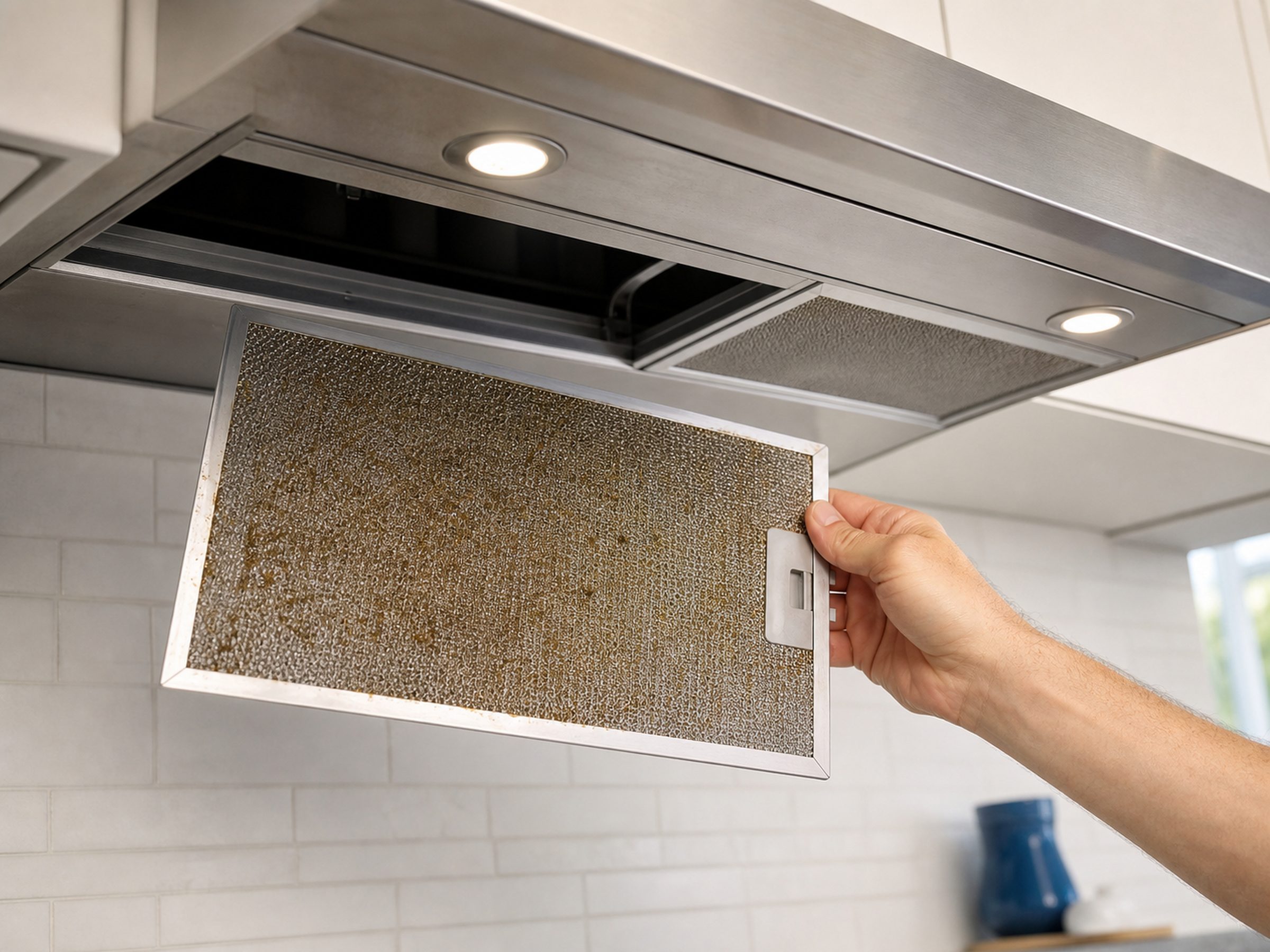
A saturated grease filter
The commonest cause and free to fix. Metal mesh filters wash; they do not need replacing.
Appliance maintenance from $129 -
An exhausted charcoal filter
On recirculating hoods only. It is a consumable with a life of months, and most people have never been told it exists.
Range hood repair from $145 -
Ducting that has collected grease
Or a hood flap held open by lint, which lets outside air back in — a Florida-specific version of this problem.
Range hood repair from $145 -
The blower, its capacitor or the speed switch
Lights working with a dead fan points here, and all three are ordinary parts.
Range hood repair from $145
In five minutes
Before you call anybody
None of it needs tools, and all of it makes the visit shorter.
-
01
Remove the filters and look through them
Against a light. That is the whole test.
-
02
Establish whether it is ducted or recirculating
A recirculating hood vents back into the room through charcoal. If yours has no duct, the charcoal filter is the answer more often than not.
-
03
Try every fan speed and the lights
What still works narrows this more than any measurement.
-
04
Hold a tissue to the filter with the fan on high
It should hold. If it falls, there is very little air moving.
How it shows up
What people describe when they call
A shortcut
Narrow it down before anybody arrives
A description of the behaviour leaves a few possible causes. A code names the subsystem before anybody opens anything, which is why it is worth photographing before it clears.
If there is no code at all
On a hood, the data plate is inside the frame. All models
In more detail
About GE range hood not pulling air
Take the filters out and hold them up to the light
A mesh grease filter saturated with cooking oil passes very little air and looks almost normal in place. If you cannot see light through it, that is your extraction. Metal mesh filters go in the dishwasher; charcoal filters do not — they are consumables and get replaced.
Nothing to look up, so we look at what works
Where GE publishes no codes, diagnosis is done by elimination against the functions the appliance has: lights, each speed, the damper, and on a downdraft the lift. Trying all of them before we arrive genuinely shortens the visit.
Why this one matters more than it seems
Extraction that has quietly halved puts cooking grease on cabinets, ceilings and inside the duct. It is a cleaning problem that becomes a fire risk, and it is entirely preventable with filters.
This article is based on:
- Official manufacturer documentation
- Internal repair procedures
- Technician repair history
- Company quality standards

Before you book
Questions about GE range hood not pulling air
How often should the filters be done?
Metal mesh, monthly in a kitchen that cooks. Charcoal, every six to twelve months depending on use — and it is a replacement, not a wash.
The fan is loud but weak.
Loud and weak together usually means the blower is working against a restriction rather than failing. Filters and duct first.
Where we do it
Across Miami-Dade, Broward, and Palm Beach
Same terms everywhere we go: an on-site diagnostic first, the price agreed in writing, and the exact figure confirmed once we have seen the unit.
Neighborhoods people ask for by name