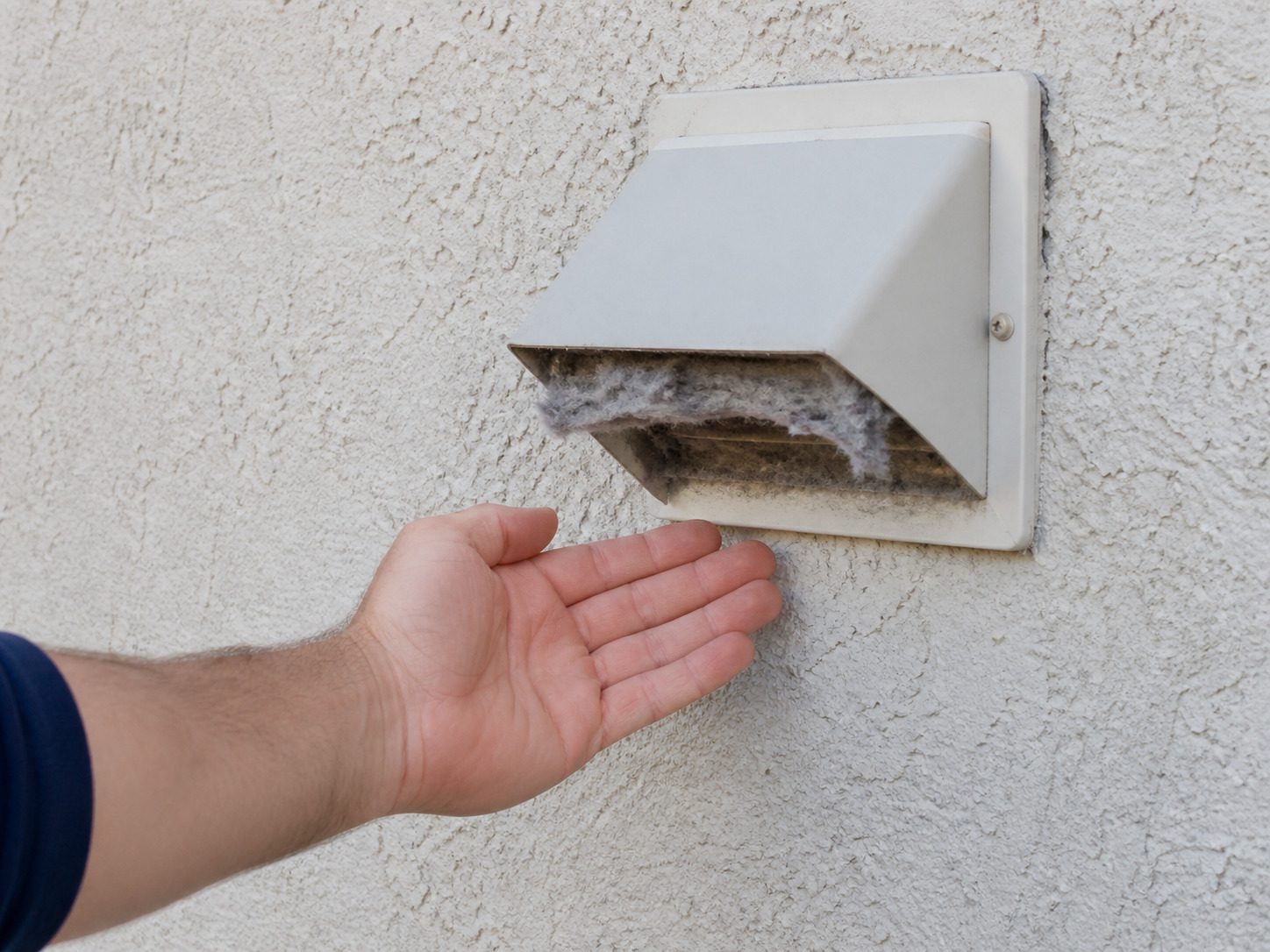
- “Two cycles to dry what used to take one”
- “The load is hot but still damp”
- “The laundry room gets warm and humid”
Symptom
GE dryer takes too long or will not dry
The vent, until proven otherwise — and GE's own troubleshooting says the same. A duct packed with lint, crushed behind the machine, or running too far horizontally will pass air but not enough of it, and the machine runs cycle after cycle doing very little. In this county the run is usually long and it carries humid air, which makes it fill faster than anywhere dry.
- From $95 diagnostic, credited to the repair
- 59 cities and neighborhoods covered
- OEM parts available on order
- In writing the price, before anything is opened
Five ordinary causes
What this usually turns out to be
Cheapest and commonest first, which is also the order we check them in. They sit hundreds of dollars apart, and only the unit settles which one is yours.
-
A restricted vent duct
The overwhelming favorite. It costs drying time and electricity, and it is what kills heating elements early.
Dryer vent cleaning from $125 -
A crushed transition hose
The flexible section behind the machine, squashed when the dryer was pushed back into place.
Dryer vent cleaning from $125 -
A vent hood flap held open by lint
Which lets humid outside air back in — a specifically Florida version of this problem.
Dryer vent cleaning from $125 -
A heating element or cut-out on its way out
Often a consequence of the above rather than an independent failure.
Dryer heating element replacement from $185 -
An overloaded drum
Free to fix. A drum packed tight cannot tumble, and clothes that do not tumble do not dry.
Diagnostic visit from $95
In five minutes
Before you call anybody
None of it needs tools, and all of it makes the visit shorter.
-
01
Check the airflow at the outside hood
Strong flow means the duct is clear and the diagnosis moves inside the machine.
-
02
Pull the machine out and look at the transition hose
Crushed, kinked or disconnected, and all three are common.
-
03
Clean the lint filter and look through it against the light
A filter coated with fabric softener residue passes far less air than it appears to.
-
04
Try a smaller load
If a half load dries normally, the problem is airflow or capacity rather than heat.
How it shows up
What people describe when they call
A shortcut
Narrow it down before anybody arrives
A description of the behaviour leaves a few possible causes. A code names the subsystem before anybody opens anything, which is why it is worth photographing before it clears.
If there is no code at all
On a washer or dryer, the data plate is inside the door opening. All models
In more detail
About GE dryer takes too long or will not dry
Feel the air at the outside vent while it runs
It should be moving strongly enough to hold your hand off the flap. If it is a trickle, the duct is restricted and that is your answer — not the heating element, not the timer, and not the machine. This one check separates the commonest dryer problem from every other one on this page.
A dryer is a fan with a heater in it
Everything it does depends on air leaving the building. When the duct restricts, the machine still heats and still tumbles, so it looks like it is working — and it is doing very little. That is why the vent is the first thing we check and the first thing worth spending money on.
The part that is about safety
A restricted vent is the recognized fire risk in a laundry room, and a dryer that has begun taking two cycles is telling you about it. That is the honest reason we push vent work rather than parts.
A GE dryer not drying is the vent until proven otherwise, and the proof takes a minute: feel the air at the outside hood while the machine runs.
This article is based on:
- Official manufacturer documentation
- Internal repair procedures
- Technician repair history
- Company quality standards

Before you book
Questions about GE dryer takes too long or will not dry
Is vent cleaning really necessary or is it an upsell?
We measure the airflow before and after, so it is not a matter of opinion. In this climate, once a year for most households and more with pets.
It dries fine on high heat but not on low.
That is still airflow. A restricted duct shows up first on the gentler cycles, which have less heat to compensate with.
Where we do it
Across Miami-Dade, Broward, and Palm Beach
Same terms everywhere we go: an on-site diagnostic first, the price agreed in writing, and the exact figure confirmed once we have seen the unit.
Neighborhoods people ask for by name