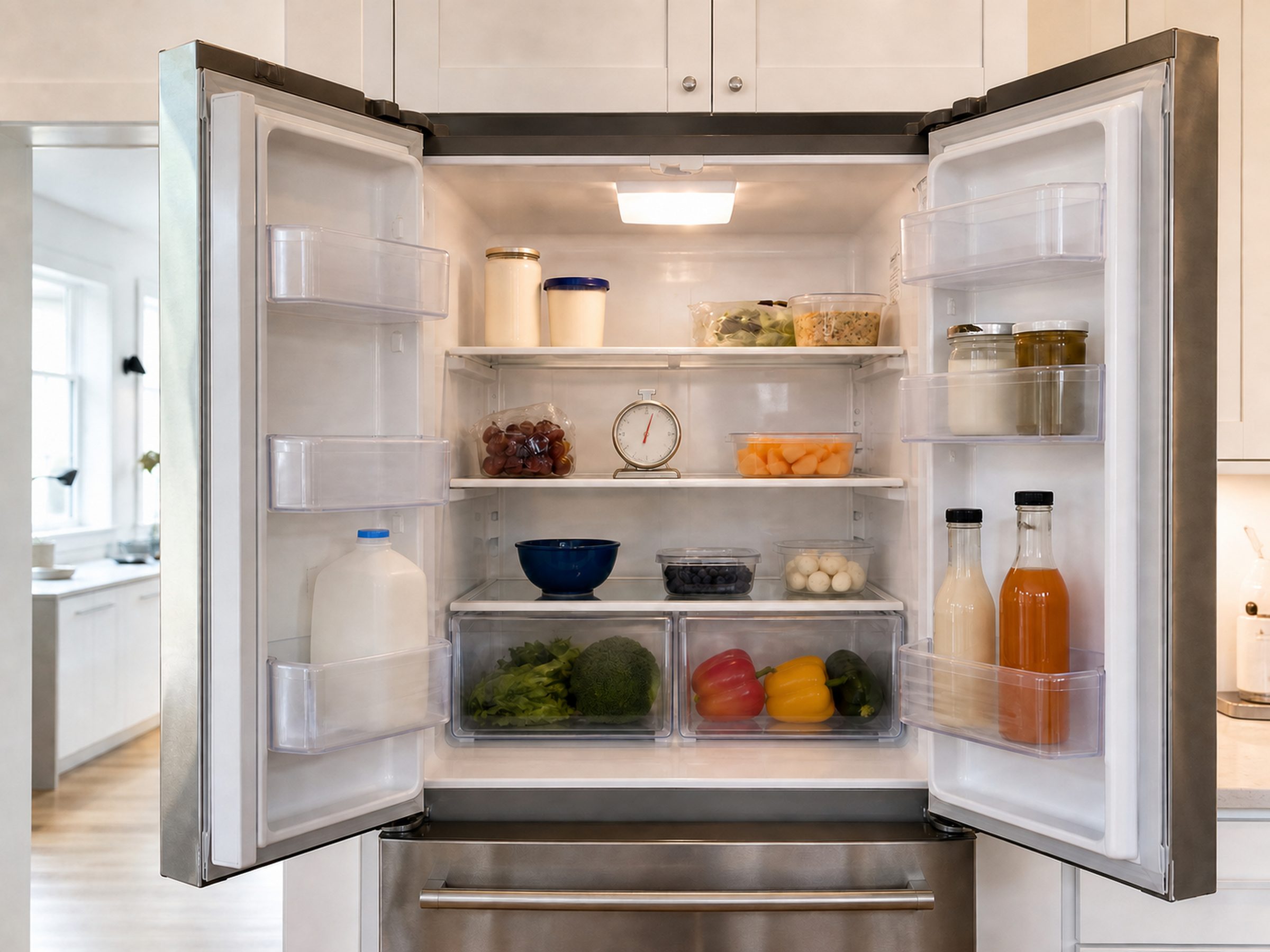
- “Running and lit, and nothing is cold”
- “Started after a delivery, a storm or a power cut”
- “The freezer may still be fine while the fridge is not”
Symptom
GE refrigerator not cooling
The most common call on any make, and on a GE there is a free answer to rule out first that nobody expects: demo mode runs the lights and the controls and switches the cooling off on purpose. After that, GE's own troubleshooting order is settings, then airflow, then defrost — and the sealed system everybody fears is last.
- From $95 diagnostic, credited to the repair
- 59 cities and neighborhoods covered
- OEM parts available on order
- In writing the price, before anything is opened
Five ordinary causes
What this usually turns out to be
Cheapest and commonest first, which is also the order we check them in. They sit hundreds of dollars apart, and only the unit settles which one is yours.
-
Demo mode, which is not a failure
GE's DE code. Lights and controls alive, refrigeration off on purpose. Costs nothing to rule out and explains a cabinet that has never been cold since it arrived.
Diagnostic visit from $95 -
The settings, and the time since they changed
GE recommends 37°F in the fresh food compartment and 0°F in the freezer. A cabinet takes hours to settle after a change, so a reading taken ten minutes later proves nothing.
Diagnostic visit from $95 -
Airflow — the vents, the load and the condenser
A cabinet packed to the back wall, a vent behind a cereal box, or a coil full of what Miami floors carry. All three produce this with nothing broken, and the coil is the one GE names first.
Condenser and airflow service from $135 -
The defrost circuit
The signature is a fresh food compartment that warms over days while the freezer stays cold, and a manual defrost that fixes it for a few days. GE's dE code reports it directly.
Defrost system repair from $185 -
The sealed system, last
Real, expensive, and rarer than the quotes in this city suggest. It is ruled in by measured pressures rather than by a warm cabinet.
Sealed system repair from $650
In five minutes
Before you call anybody
None of it needs tools, and all of it makes the visit shorter.
-
01
Look for DE on the display
Capital D, capital E. That is demo mode and the cooling is off on purpose. Lower-case dE is something else entirely — the defrost system.
-
02
Check both compartments with a thermometer
Not the display. Freezer cold and fridge warm is a different diagnosis from both warm, and it saves a visit to know which you have.
-
03
Put your hand near the condenser
Behind the base grille or at the back. Warm air should be leaving. Nothing leaving points at the fan or a coil that has packed solid.
-
04
Check the door seals with a sheet of paper
Close the door on it and pull. If it slides out freely the seal has let go there, and in this climate that is enough to cost you the cabinet.
How it shows up
What people describe when they call
A shortcut
Narrow it down before anybody arrives
A description of the behaviour leaves a few possible causes. A code names the subsystem before anybody opens anything, which is why it is worth photographing before it clears.
If there is no code at all
The data plate is inside the cabinet, upper left wall or behind the grille. All models
In more detail
About GE refrigerator not cooling
The fastest check is free and takes a minute
Look at the display for DE. GE lists it as demo mode: the lights work, the controls respond and the cooling system is switched off deliberately, because that is how showroom floor models run. Their own first step is to unplug the refrigerator for a minute or two and plug it back in. An appliance sold from a showroom floor arrives in this mode more often than anybody expects, and it looks perfectly healthy while doing nothing at all.
Cold is moved as much as it is made
A refrigerator makes cold in one place and has to move it around a cabinet that gets opened all day. Most calls that arrive as a dead compressor turn out to be about the moving rather than the making — a fan, a blocked vent, a condenser nobody has cleaned in six years. That is the cheaper half of the diagnosis and an honest visit starts there.
Two codes, one keystroke apart, opposite answers
GE lists DE as demo mode and dE as the defrost system not having run in 24 hours. One is a setting somebody enabled by accident and costs nothing; the other is a repair. They differ by the case of one letter, and every search anybody types loses that distinction.
What this climate does
Every door opening in South Florida puts wet air into the cabinet. The defrost system spends its life clearing ice a drier house would never make, and a tired door seal multiplies the work. That is why seals and defrost circuits appear so high on this page and so low on the same page written anywhere north of here.
This article is based on:
- Official manufacturer documentation
- Internal repair procedures
- Technician repair history
- Company quality standards
Before you book
Questions about GE refrigerator not cooling
It has never been cold since it was delivered.
Check for DE on the display before anything else. Floor models are sold in demo mode and arrive still in it, and the appliance looks completely normal while the cooling is switched off.
The freezer is fine but the fridge is warm.
That is close to a diagnosis on its own. It is usually the defrost circuit or the air damper between the compartments, and neither of those is a compressor.
Is it worth repairing?
GE's serial carries a two-letter date code, so we can tell you the age of the appliance before quoting. That is what decides it more than the symptom does.
Where we do it
Across Miami-Dade, Broward, and Palm Beach
Same terms everywhere we go: an on-site diagnostic first, the price agreed in writing, and the exact figure confirmed once we have seen the unit.
Neighborhoods people ask for by name