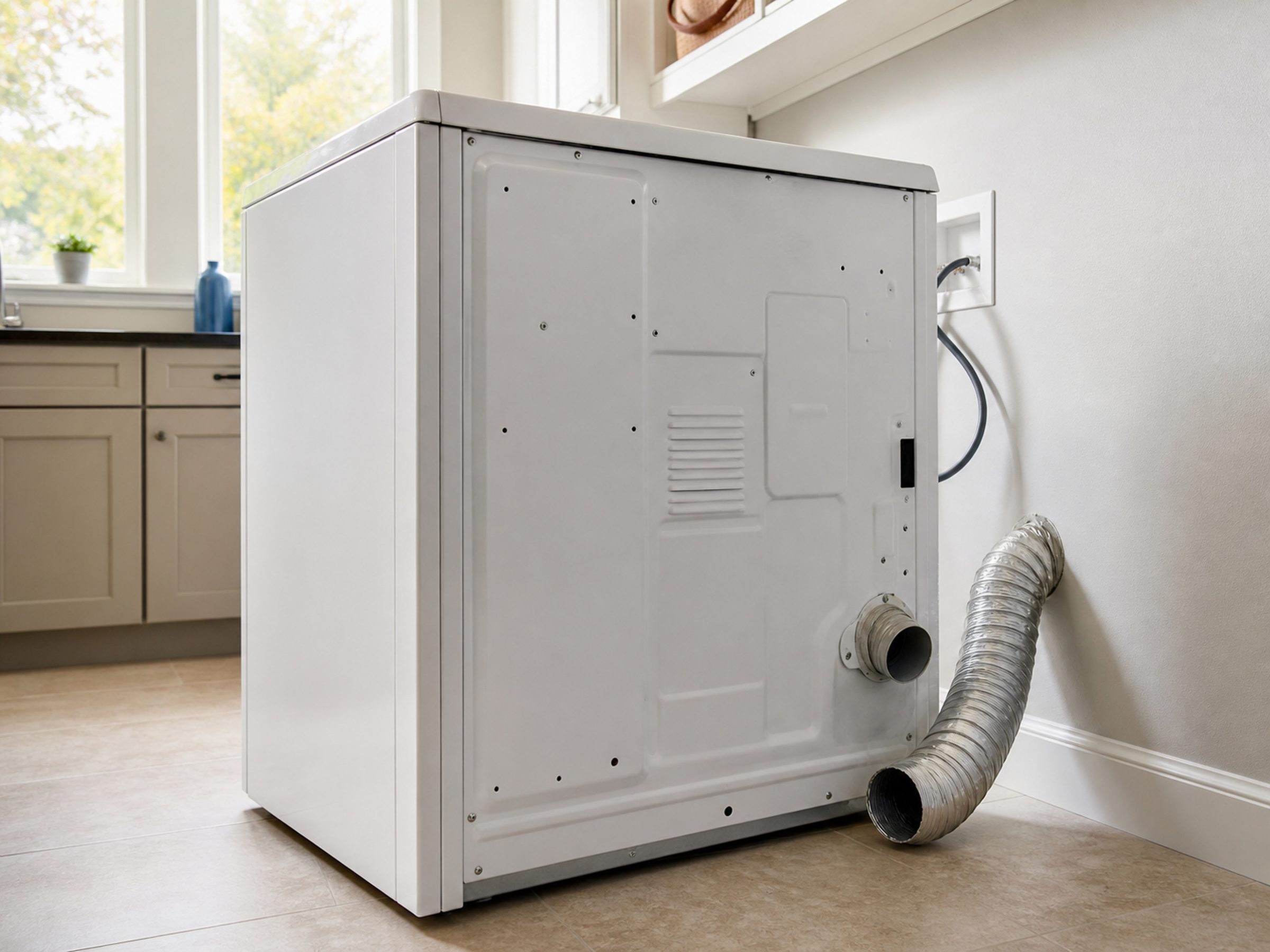
- “Tumbles normally, no heat at all”
- “Clothes come out cold and damp”
- “It happened suddenly rather than gradually”
Symptom
GE dryer runs but does not heat
On an electric dryer this is the element or a thermal cut-out — and the cut-out is very often a symptom of the vent rather than a part that simply aged. On gas it is the igniter, the flame sensor or the valve coils, diagnosable by watching one ignition cycle. Before either, there is a supply check that costs nothing.
- From $95 diagnostic, credited to the repair
- 59 cities and neighborhoods covered
- OEM parts available on order
- In writing the price, before anything is opened
Five ordinary causes
What this usually turns out to be
Cheapest and commonest first, which is also the order we check them in. They sit hundreds of dollars apart, and only the unit settles which one is yours.
-
A half-lost supply, on electric
One leg of a 240V supply gone. The drum turns, nothing heats, and nothing inside the appliance has failed.
Diagnostic visit from $95 -
The heating element
The ordinary electric answer, and an ordinary part.
Dryer heating element replacement from $185 -
A thermal cut-out that has opened
Usually because the vent restricted and the housing overheated. Replacing it without clearing the vent guarantees a second call.
Dryer heating element replacement from $185 -
The igniter, on gas
The classic gas answer: it still glows but no longer draws enough current to open the safety valve, so it looks like it is working.
Gas dryer igniter and valve repair from $195 -
Flame sensor or valve coils, on gas
It lights and goes out, or never lights at all. One ignition cycle watched tells us which.
Gas dryer igniter and valve repair from $195
In five minutes
Before you call anybody
None of it needs tools, and all of it makes the visit shorter.
-
01
Check the breaker, both halves
On electric. A double-pole breaker can lose one side and look fine.
-
02
Is it gas or electric?
The diagnosis diverges completely, and the symptom from the doorway is identical.
-
03
Check the vent while you are there
Because a cut-out that opened has a reason, and the reason is usually airflow.
-
04
Listen at the start of a cycle, on gas
The igniter should glow and the burner should light within a minute. Where the sequence stops names the part.
How it shows up
What people describe when they call

A shortcut
Narrow it down before anybody arrives
A description of the behaviour leaves a few possible causes. A code names the subsystem before anybody opens anything, which is why it is worth photographing before it clears.
If there is no code at all
On a washer or dryer, the data plate is inside the door opening. All models
In more detail
About GE dryer runs but does not heat
On an electric dryer, check both legs of the supply
An electric dryer runs its motor on one leg and its heater on the other. Lose one and the machine tumbles perfectly and never heats — which looks exactly like a failed element and is a tripped breaker or a loose connection. It is free to check and it is more common than people expect, especially after electrical work.
Why the vent belongs on a no-heat page
Thermal cut-outs are protection. They open because the housing got too hot, and the housing gets too hot because air is not leaving. Fitting a new cut-out and closing the machine up is a repair that fails again, which is why we do not quote this one without the vent.
Gas and electric, from the doorway
Identical symptom, different parts, different prices. Knowing which you have before the visit is why we ask on the phone, and it is why the model number is worth finding.
This article is based on:
- Official manufacturer documentation
- Internal repair procedures
- Technician repair history
- Company quality standards
Before you book
Questions about GE dryer runs but does not heat
It heats a little but not much.
On electric that can be one element coil of two, or a restricted vent. On gas it is more often the flame going out early.
Could it be the timer?
Rarely on a no-heat symptom — a timer problem usually shows as a cycle that never advances rather than a cold one.
Where we do it
Across Miami-Dade, Broward, and Palm Beach
Same terms everywhere we go: an on-site diagnostic first, the price agreed in writing, and the exact figure confirmed once we have seen the unit.
Neighborhoods people ask for by name